Loading...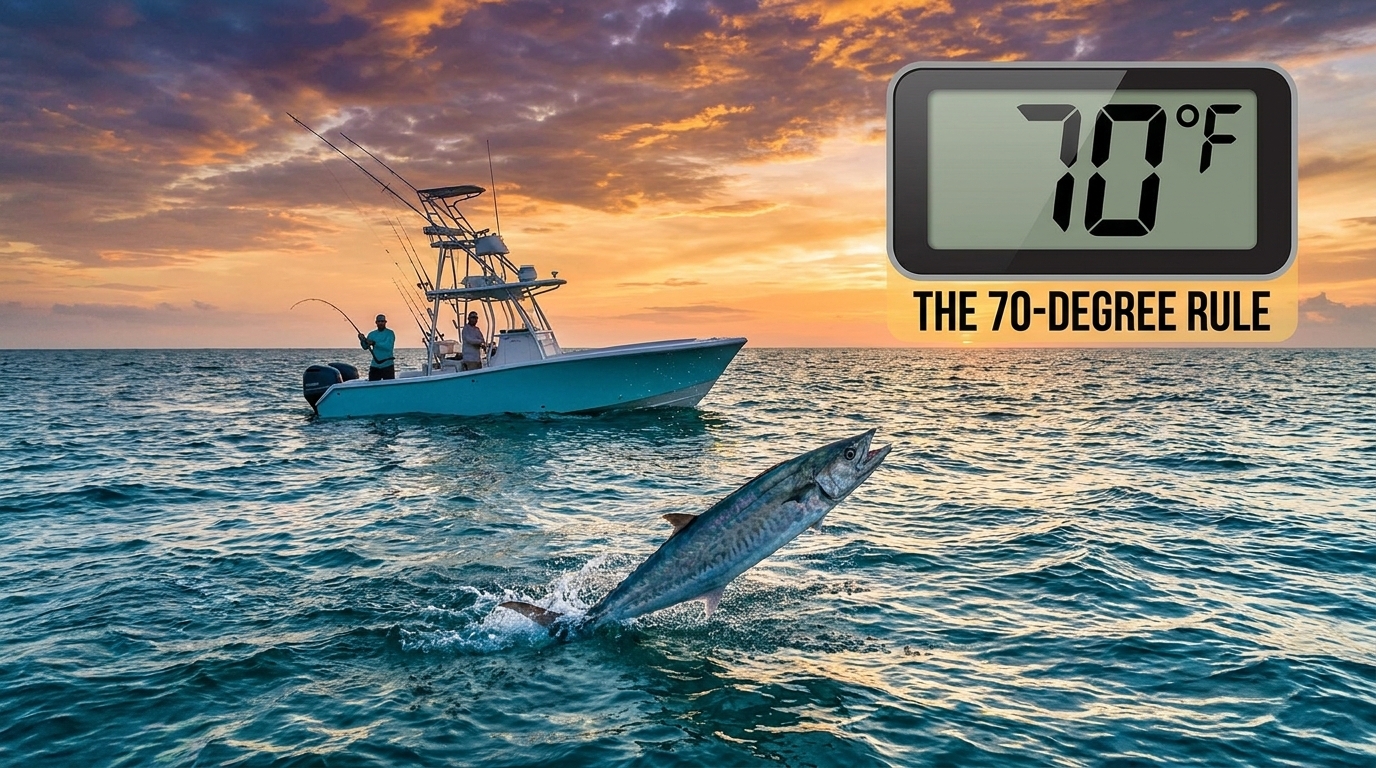
Right now, mid-August, the Gulf off Mexico Beach is running in the low-to-mid 80s at the surface. That's a few degrees too hot for a truly locked-in king mackerel bite. But every north wind, every cool morning, every degree the Gulf sheds through September and October pulls that water back into the sweet spot — and the kings turn on. Here's how to read it, and when to book.
The 70-Degree Rule, in Plain English
King mackerel are picky about temperature. Not fussy like a trout picking flies — picky like a fish that will simply leave water it doesn't like. Decades of catch data and captain logbooks point to a tight band:
Kings feed hardest in 68°F to 78°F water, with the strongest, most consistent bite between 70°F and 74°F. Above 80°F, they scatter deep or push north-south chasing cooler pockets. Below the mid-60s, they're gone offshore.
That's the rule. Everything else — where to troll, when to book, whether to run 8 miles or 25 — is just applying it to the water in front of you.
Where the Panhandle Sits Right Now
Mid-August surface temps on the nearshore reefs out of Mexico Beach, Panama City Beach, and Destin are running 83°–86°F. That's why the kings you're hearing about are being caught deeper, earlier in the morning, or along tight temperature breaks where cooler upwelled water meets the warm surface soup.
The good news: the Gulf cools fast once the calendar flips. Historically, Panhandle nearshore SSTs drop into the high 70s by late September and hit the low-to-mid 70s — the money zone — through October and into early November. That's the booking window this article is really about.
How to Read a NOAA SST Chart Without a Meteorology Degree
You don't need a subscription service. NOAA's CoastWatch and the free Hilton's-style SST overlays most captains reference show two things that matter for kings:
- Absolute surface temperature. Look for water in that 70°–78°F band. In September–October off the Panhandle, that's usually somewhere between the 60-foot curve and the 120-foot curve.
- Temperature breaks. A 2°F change over a short distance — visible as a color shift on the chart — concentrates bait, and kings stack on bait. A hard break near the 100-foot curve is a classic king setup off Mexico Beach and PCB.
If you see a chart where the whole shelf is one blanket of 84°F red, stay home or fish inshore. When you start seeing yellows and greens creeping in from the north, and breaks tightening up along the mid-shelf, it's time to move.
The Booking Calendar: What "When" Really Looks Like
Here's how the 70-Degree Rule translates into a Panhandle trip planner for the rest of 2026:
- Late August (now): Water too warm on top. Kings possible but scattered — a shoulder window. Better paired with a bottom trip for snapper (still hot per PCB Life's ongoing coverage) or the September 1 gag grouper opener we covered in the 31-day gag window guide.
- First cool front (typically mid-September): The first sustained north wind of the fall drops surface temps 3°–5°F in 48 hours. This is the tripwire. When it happens, book fast.
- Late September through October: Prime time. Surface temps settle into the 72°–78°F range across the nearshore and mid-shelf grounds Captain Dan runs out of Mexico Beach. Live-bait slow-trolling and stinger-rigged cigar minnows come into their own.
- Early November: The tail end. Big smoker kings — 30 pounds and up — often show as the water hits the low 70s and bait pushes south along the coast.
Five Signals That Say "Book This Week"
Watch for these together. When three or more line up, the phone should already be in your hand:
- Nearshore SSTs drop below 80°F.
- A tight temperature break sets up within a reasonable run of your home port — usually near the 80–120-foot curve.
- Bait pods (menhaden, cigar minnows, hardtails) are stacked on nearshore reefs and buoys.
- A north-wind cold push is forecast or just passed. (We wrote about post-front fishing windows in the 48-hours-after-Bertha piece — same principle applies to cool fronts.)
- Morning surface temps are noticeably cooler than afternoon peaks — a sign the water column is starting its fall turnover.
Why Mexico Beach Is Worth the Extra Ten Miles
Mexico Beach doesn't have PCB's strip-side traffic, and that matters when you're chasing a temperature break. Less boat pressure on the nearshore reefs means bait holds longer and kings settle in instead of running. A recent Spanish-language travel piece just called Mexico Beach the quiet, turquoise-water alternative to the busier Panhandle strip — anglers have known that for years. When the SST chart lights up in October, launching from Mexico Beach puts you on the fish before the PCB fleet has cleared the pass.
Kings Are the Best "First Big Fish" a Family Will Ever Hook
Worth saying out loud: king mackerel are the perfect crossover species. Serious sportfishermen love them for the SKA-style live-bait game. Vacationing families love them because they scream drag, jump, and pull like something twice their size — on tackle a 10-year-old can hold. When the temps are right, a nearshore king trip is the most fun a first-time offshore angler will have on the Gulf.
The Bottom Line
The 70-Degree Rule isn't complicated. Watch the Gulf cool. Watch for breaks. Book when the chart tells you to. From roughly mid-September through October, the Panhandle offers one of the most reliable king mackerel bites in the Gulf — and it closes fast when the water finally drops through the 60s.
Ready to be on the water when the next cold front hits? Reserve a trip with Captain Dan out of Mexico Beach — a $500 inshore or $700 reef/nearshore charter puts you in position when the temps flip.
And if you'd rather have us tell you the moment the SST chart turns green: subscribe to our newsletter. We'll send the next water-temp update — and the booking window — straight to your inbox.