Loading...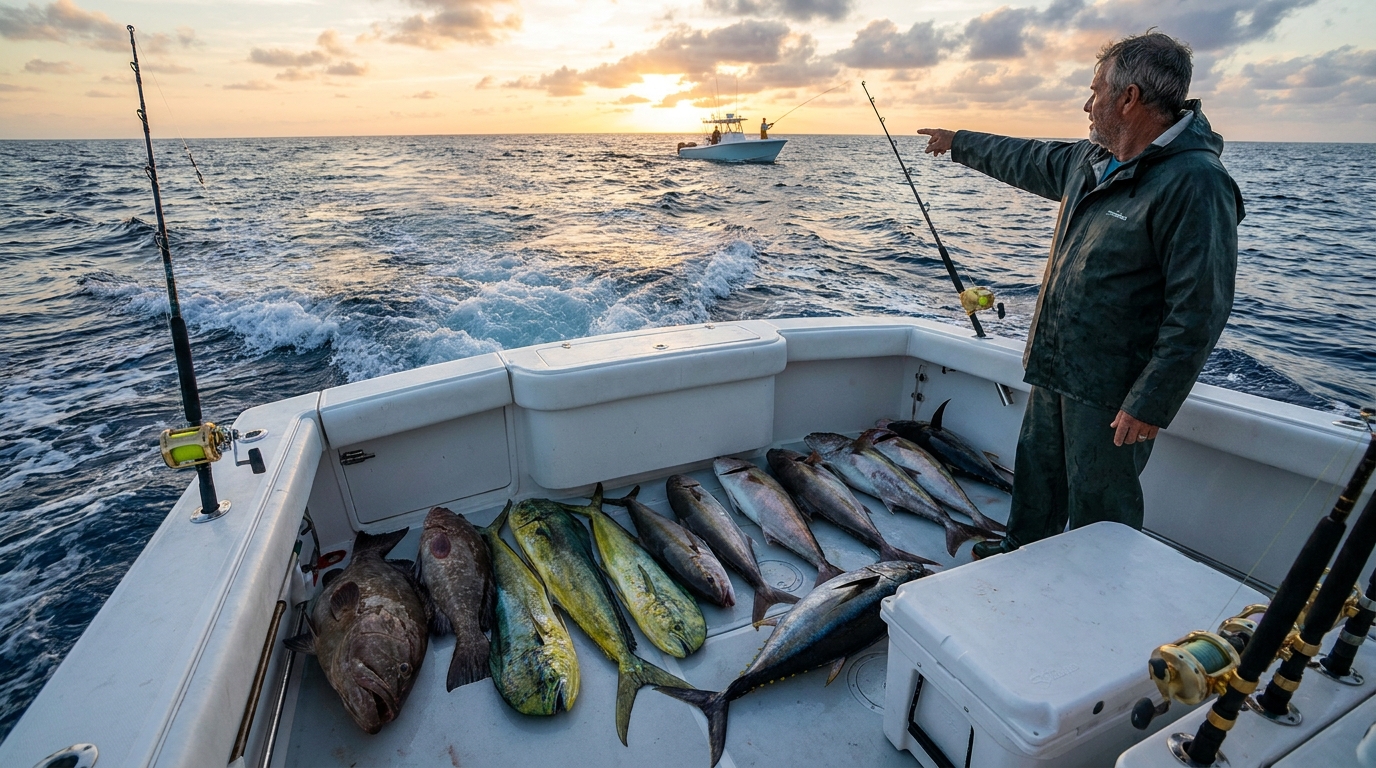
In the same news cycle that brought genuinely good news to Gulf shrimpers — early-season catches off the Mississippi, Alabama, and Florida Panhandle coasts running strong enough to give working captains reason for cautious optimism[1] — the federal fisheries management framework delivered two diametrically opposed outcomes to recreational charter fleets a few hundred miles apart. A federal judge effectively ended Florida's 2026 red snapper season before it could begin[6], while South Carolina's season was stretched from two days to roughly two months[7]. For Panhandle charter operators heading into peak summer, that contrast isn't an abstract regulatory footnote. It's a direct hit to the single most lucrative species on the summer trip board — and a forced pivot toward the rest of what the Panhandle still has to offer.
Same Framework, Opposite Outcomes
Both Florida and South Carolina manage their recreational red snapper allocations under the same federal architecture — the South Atlantic and Gulf Fishery Management Councils, working from SEDAR stock assessments and NOAA Fisheries quotas. Yet within a single week, that shared framework produced inverse results. A federal court ruling concluded that Florida's planned 2026 season could not proceed, leaving Panhandle captains who had already booked June and July charters around the species scrambling to refund deposits or rework trips[6]. The Florida Fish and Wildlife Conservation Commission, which has been unusually active this week — publishing gray triggerfish parameters, issuing new executive orders on temporary closures, and running its "Outta the Woods" conservation column — now faces pressure to find a workaround[3][4][5].
South Carolina, by contrast, won a dramatic expansion. State officials there are now planning public information sessions to walk anglers and charter operators through a season that runs roughly from early July into late summer, rather than the punishing two-day window of recent years[8][9]. The divergence reflects different allocation math, different stock-assessment inputs between the South Atlantic and Gulf components, and — in Florida's case — a successful legal challenge that the state's regulators did not see coming.
What This Means for the Panhandle Charter Business
Red snapper is not just one species on a Panhandle charter menu. For fleets out of Destin, Panama City Beach, and Pensacola, it is the summer headliner — the species that fills six-pack boats at premium rates from Memorial Day through Labor Day. Industry estimates have long pegged red snapper as the single biggest driver of June–August offshore bookings on the Florida Gulf coast, with full-day reef trips routinely priced in the $1,400–$2,200 range when snapper is on the schedule.
With Florida's 2026 season effectively cancelled and South Carolina's stretched to roughly two months, a measurable share of summer trip dollars is going to move across state lines — and the question for Panhandle operators isn't whether bookings shift, but how fast they can reposition the offer.
The competitive risk is real. Charleston, Hilton Head, and Murrells Inlet charter fleets now have a two-month window to market federally legal red snapper trips that Panhandle captains cannot. Trade-publication chatter this week suggests some Southeast anglers who would normally fly into Northwest Florida Beaches International or Pensacola are already pricing out drive trips to South Carolina instead. For a Panhandle charter sector still rebuilding bookings post-pandemic and absorbing fuel costs with Gulf marine diesel above $3 a gallon, losing even 10–15% of summer offshore volume to a competing coast is material.
The Panhandle Pivot: What Else Is Biting
Here is where the story turns from defense to offense. The Florida Panhandle is not a one-species coast, and operators who reposition quickly have a deep bench of alternatives to put in front of customers this summer.
Gray triggerfish parameters have just been published by FWC, giving captains a clearly defined window to build trips around a hard-fighting reef species that customers consistently rate as a top eating fish[4]. Vermilion snapper, mangrove snapper, amberjack, scamp grouper, and red grouper all remain on the Panhandle reef menu and can anchor full-day offshore trips at price points close to what red snapper commanded. Inshore, speckled trout, redfish, flounder, and tripletail on Choctawhatchee and St. Andrews bays support half-day family trips that don't depend on federal offshore quotas at all. And the early shrimp season strength[1] hints at a broader baitfish and forage abundance that typically translates into strong nearshore king mackerel and Spanish mackerel runs through July.
For retail-side operators — tackle shops, marinas, and booking platforms — the merchandising message for the next 60 days should be explicit: the Panhandle is open for fishing, just not for keeper red snapper. Catch-and-release red snapper trips remain legal and can be marketed honestly as a chance to tangle with the species without the harvest. Multi-species reef trips, inshore light-tackle, and offshore pelagics for mahi and blackfin tuna out of Destin's deep-water access all become the lead offer.
The Wild Card: Hurricane Season and Shrimp Economics
Compounding the planning challenge, NWS Mobile/Pensacola released its 2026 Hurricane Preparedness Guide the same week, a standard reminder that any summer revenue gains across the Gulf — charter or commercial — are weather-contingent[2]. A single named storm tracking into the northern Gulf in July or August can erase weeks of bookings and damage the early shrimp-season momentum that has Coast fishermen smiling for the first time in three years.
That shrimp optimism matters to the charter side too. With imports still accounting for roughly 94% of U.S. shrimp consumption and dockside prices near 20-year lows in real terms, a strong domestic harvest paired with the late-2024 countervailing duty actions on Ecuador, India, Vietnam, and Indonesia could finally lift ex-vessel prices for medium and large brown and white shrimp out of the $2.50–$4.50/lb break-even zone. A healthier working waterfront means a healthier customer base for everyone selling fuel, ice, bait, and boat slips on the same docks.
Forward Look
The Florida–South Carolina red snapper split is not a one-week story. It is the most visible recent example of how a unified federal framework is producing increasingly divergent state-level outcomes, and Panhandle operators should expect more, not less, of this volatility heading into 2027. The captains and retailers who treat this summer as a forced product-line expansion — leaning into triggerfish, multi-species reef, inshore, and pelagic trips while marketing the Panhandle as a destination rather than a single-species pilgrimage — will come out stronger. Those who wait for FWC or the courts to restore the old snapper-centric business model may find that the bookings, and the customers, have already driven north.
References
- Early shrimp season catches give Coast fishermen reason for optimism — FL Panhandle Fishing Reports, 31 May 2026. Link
- NWS Mobile/Pensacola 2026 Hurricane Preparedness Guide — NOAA Marine Weather – Gulf of Mexico, 31 May 2026. Link
- Outta the Woods — Florida Fish & Wildlife Conservation Commission – News, 31 May 2026. Link
- Gray Triggerfish — Florida Fish & Wildlife Conservation Commission – News, 31 May 2026. Link
- Executive Order — Florida Fish & Wildlife Conservation Commission – News, 31 May 2026. Link
- Judge ruling ends Florida's red snapper season before it even has a chance to begin — First Coast News, 31 May 2026. Link
- Red snapper season in SC extended from 2 days to 2 months this summer — The Post and Courier, 31 May 2026. Link
- All you need to know ahead of South Carolina's extended 2026 red snapper season — ABC News 4, 31 May 2026. Link
- SC plans red snapper season info sessions amid permit suspension — ABC News 4, 31 May 2026. Link